Key takeaways
- Feed a complete puppy food suitable for your puppy's growth and expected adult size.
- A general pattern is 4 meals at 8–16 weeks, 3 until six months and 2 thereafter, adjusted individually.
- Daily food quantity depends on the product's feeding guide and your puppy—not a universal cups-per-day chart.
- Use kitchen scales, and count training treats as part of total daily food intake.
- Change diet gradually and contact a vet for persistent vomiting, diarrhoea, poor appetite or abnormal growth.
Puppy feeding schedule by age: the quick-reference table
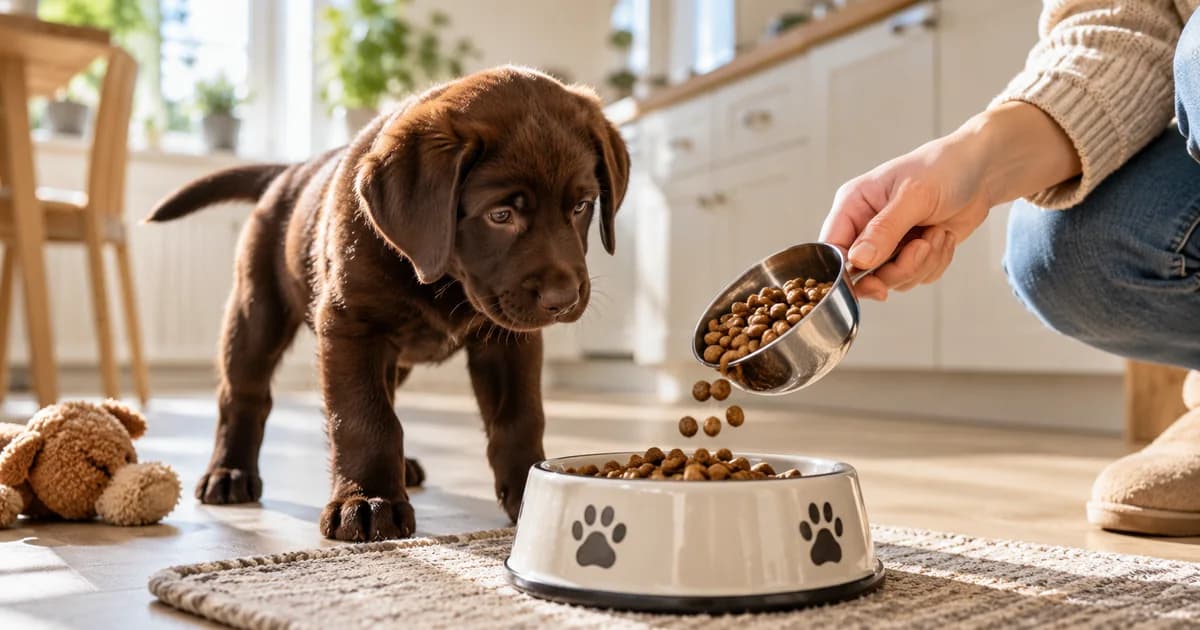
Growing puppies have small stomachs and high nutritional requirements. Several small meals generally work better than one large meal. PDSA and Blue Cross publish similar starting schedules, but these are not an instruction to ignore your veterinary team's individual plan.
| Puppy's age | Suggested meals per day | What to monitor |
|---|---|---|
| 8–16 weeks | 4 small meals | Appetite, stools, energy and appropriate weight gain |
| 16 weeks to 6 months | 3 meals | Portions as growth and the food label change |
| From around 6 months | 2 meals | Breed size, body condition and vet-recommended transition |
This table is based on the PDSA puppy feeding leaflet and Blue Cross puppy food advice.
How much food should you actually give?
There is no trustworthy one-size-fits-all number of grams for 'an eight-week-old puppy'. Food energy density differs enormously, and two puppies the same age may have very different expected adult weights. Find the daily gram allowance on the exact food packaging, using current age and expected adult size, and have your veterinary team check whether it fits your puppy's growth.
Find the daily grams
Use the manufacturer's full, age-appropriate feeding instructions; check whether the guide assumes dry food only or a mixed diet.
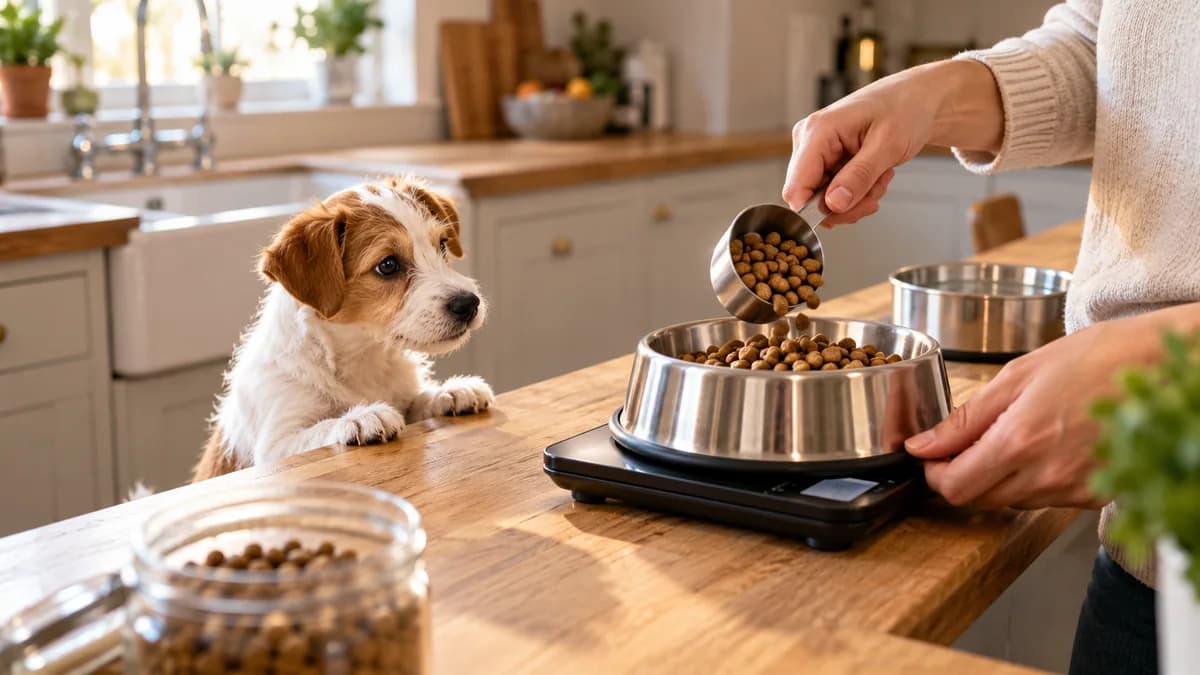
Weigh the full daily amount
Use digital kitchen scales; a scoop or cup can vary by kibble shape and brand.
Divide by your puppy's meals
Example: if your confirmed daily allowance is 160 g and your puppy eats four meals, divide into four 40 g portions. This is arithmetic, not a feeding recommendation.
Account for treats
Take training food from the day's food allowance where practical, and follow vet advice on treats and suitable rewards.
Review body condition regularly
Weigh and assess with your vet as your puppy grows; amend portions as the food guidance and individual needs change.
Choosing the right complete food for a growing puppy
A food labelled 'complete' and suitable for puppies is formulated to provide the balance of nutrients needed for growth, provided it is fed correctly. Choose one appropriate for your puppy's size and stage. If the puppy came from a breeder or rescue, find out exactly what it was already eating before making changes.
- Check the food is labelled 'complete' for the correct life stage, not simply a complementary treat.
- Keep fresh water accessible throughout the day.
- Store food in line with the manufacturer's instructions and check expiry dates.
- For giant or large breeds, ask your vet whether a growth-specific formula is needed.
- If using wet and dry food together, calculate combined daily amounts rather than doubling both allowances.
What a manageable daily feeding routine looks like
You can align meals with the household's schedule, so long as they are reasonably spaced. For a puppy on four meals, that may mean morning, late morning, afternoon and early evening. For three meals, breakfast, lunch and dinner may work. Avoid leaving a very hungry puppy with a large overnight gap without discussing their needs with a vet.
| Meal pattern | Possible rhythm | Everyday task |
|---|---|---|
| Four meals | Morning / later morning / afternoon / evening | Offer a toilet opportunity after each meal |
| Three meals | Breakfast / lunch / evening | Keep portions consistent and track stool changes |
| Two meals | Morning / evening | Balance daily amount across two meals |
How to change puppy food without upsetting digestion
Unless a vet tells you otherwise, keep the puppy's familiar food initially. If you need to change to another complete diet, introduce the new one gradually over a number of days rather than swapping abruptly. The exact pace depends on the dog and product; slow down and speak to your vet if the puppy develops gastrointestinal problems.
Connect mealtimes with toilet training and first-year records
Because puppy toilet patterns often follow meals, feeding times are useful anchors for a routine. Save the current food brand, measured daily allowance, meal frequency, weight checks and any veterinary advice. Review the routine each time the puppy grows or changes food.
Combine this guide with the puppy toilet training plan and the new puppy checklist UK to keep care simple and consistent.
Authoritative sources
Medical, regulatory and safety statements were checked against the following UK sources on 2026-10-17. Recheck changing regulations, travel rules, vaccination guidance and AI standards at least every 90 days or before a related decision.
Frequently asked questions
How many times a day should an 8-week-old puppy eat?
PDSA's general guide suggests four small meals per day from 8–16 weeks. Confirm your puppy's individual needs and daily food allowance with your veterinary team.
When can puppies go from three meals to two?
A common starting point is from around six months of age. Breed size, health and growth can change this, so check with your vet rather than switching solely because of age.
How many grams should I feed my puppy?
Use the daily feeding amount printed on your chosen complete puppy food for age and expected adult weight, adjust under veterinary guidance and weigh portions with kitchen scales.
Should I leave dry puppy food out all day?
Structured meals help you monitor appetite and portion intake. Ask your vet what feeding pattern is appropriate for your particular puppy, especially for very small dogs or those with health concerns.