Key takeaways
- England: owned cats must be microchipped before 20 weeks old (from 10 June 2024).
- The microchip must be registered on an approved database and your details must be kept up to date.
- Indoor cats are not exempt from the rule.
- If a cat is not chipped, the keeper is given 21 days to implant a chip, with a possible fine of up to £500 if they do not.
- Update the database when you move, change phone number or rehome the cat. A chip with old details can fail to reunite you.
- Scotland, Wales and Northern Ireland have their own laws. Check the current rules for where you live.
What is the cat microchipping law in England?
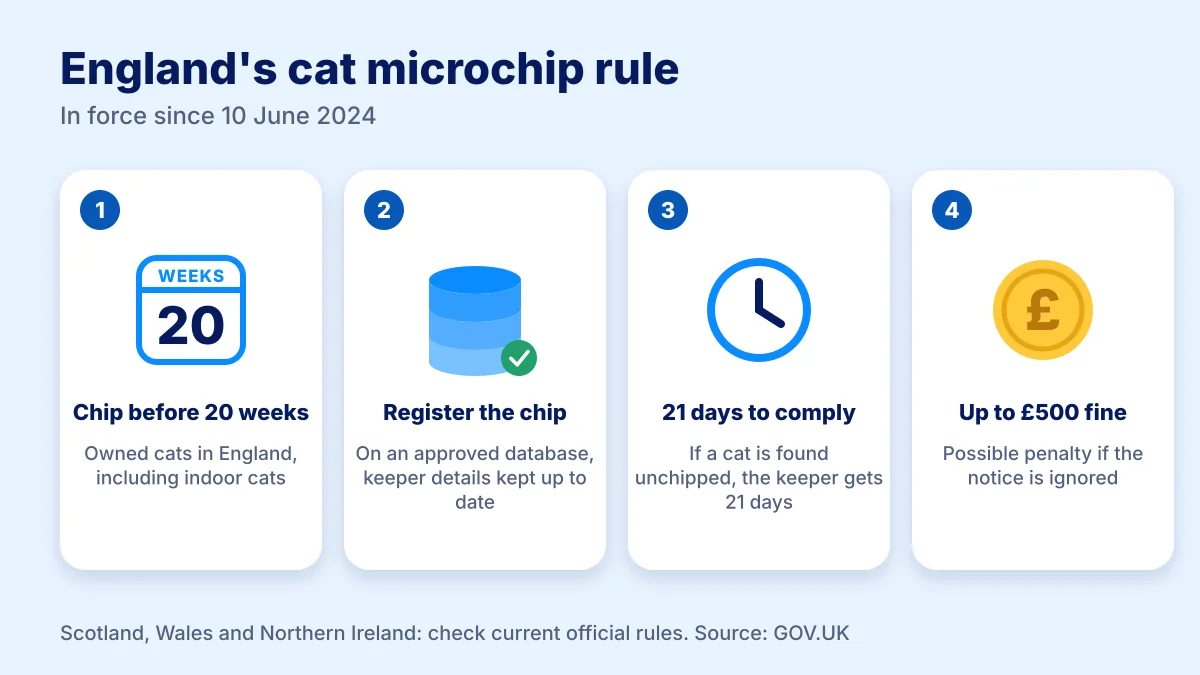
GOV.UK announced that from 10 June 2024 all cat owners in England must ensure their cat is microchipped before it reaches 20 weeks of age, with contact details stored and kept up to date on an approved pet microchipping database. The legal basis is the Microchipping of Cats and Dogs (England) Regulations 2023. BSAVA confirms that the requirement includes cats that usually only stay indoors.
What happens if a cat is not microchipped?
According to GOV.UK and local council guidance, keepers found not to have microchipped their cat are given 21 days to have one implanted, and failure to comply can lead to a fine of up to £500. Councils and animal-welfare bodies describe the aim as helping lost, stolen and stray cats get back to their owners.
For a new kitten the simplest way to avoid trouble is to plan the chip as part of the first vet visits instead of leaving it to the last week before 20 weeks.
When should a kitten be microchipped?
The legal limit is before 20 weeks, but many kittens are chipped earlier. The Cat Action Trust notes there is no minimum age for microchipping, and vets commonly offer it at a vaccination visit or during neutering. Because neutering is generally recommended from around four months, which is before 20 weeks, some owners book the chip at the first or second vaccination so it cannot slip.
Ask the breeder or rescue first
Many kittens are already chipped. Ask for the chip number, the database it is registered on and any registration paperwork.
Check the chip at the first vet visit
Ask the vet to scan the kitten and confirm the number matches your documents.
Chip by the deadline if needed
Ask your vet or a trained implanter to implant a chip and register the details.
Confirm registration in writing
Log in to the database or ask for a confirmation. A chip with no registered keeper does not help.
Petlog's guide suggests expecting to pay roughly £15–£30 for a microchip and registration, though prices vary by practice and some charities or councils run offers. Ask in advance.
Register the chip and keep your details current
Microchipping is only half of the requirement. The keeper details must be on an approved database, and they have to remain accurate. A kitten with a chip registered to a former address, a breeder or a disconnected phone number is hard to reunite with you.
- Note the 15-digit microchip number and the database name
- Keep the registration confirmation with your kitten's documents
- Update the details when you move, change phone number or email
- Update the record if the cat is passed to a new keeper
- Ask the vet to scan the chip at annual check-ups to confirm it still reads
- Store the number in your kitten's pet profile for quick access
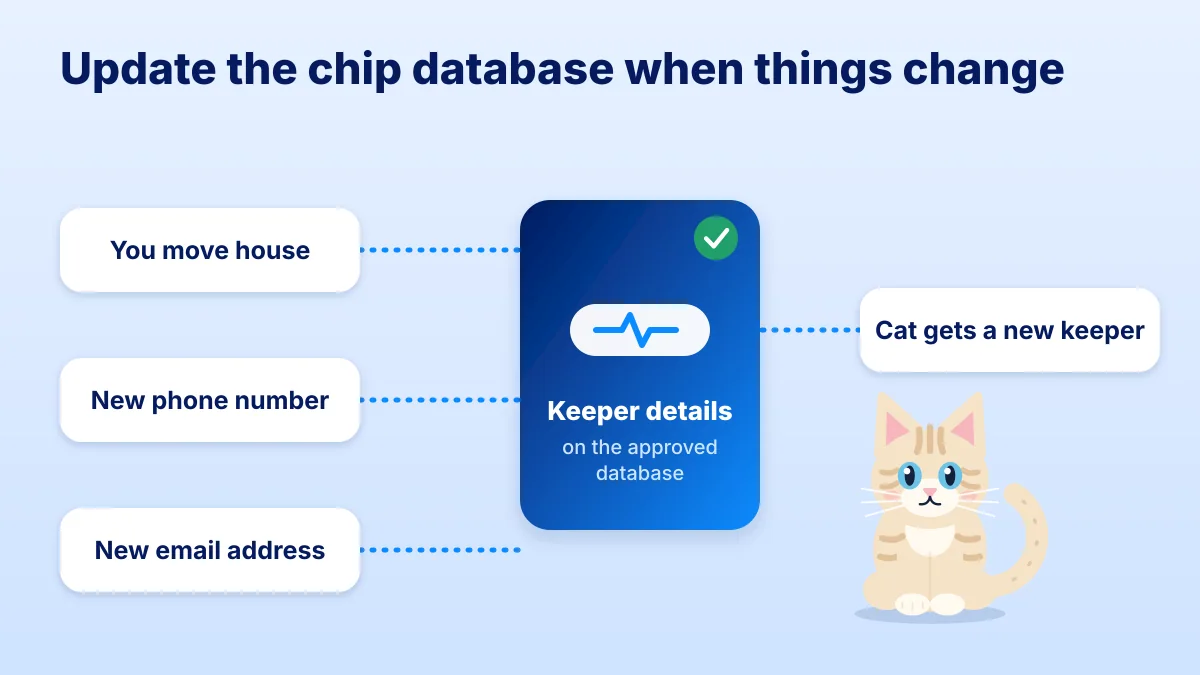
Local-authority guidance explains that when a cat changes keeper, either the previous or the new keeper can update the database, and the previous keeper should confirm it was done.
Scotland, Wales and Northern Ireland
Animal welfare is devolved. At the time of checking on 7 November 2026, we found no evidence that compulsory cat microchipping applies in Scotland, Wales or Northern Ireland. BSAVA recorded that mandatory cat microchipping had not been added to the other nations' regulations as of April 2025, Cats Protection was still urging the Scottish Government to introduce it in July 2026, and the Welsh Government had said it would consider extending compulsory microchipping to cats by 2026. Rules can change, so check the official government site for where you live. Microchipping is still strongly recommended everywhere.
Compare the other health timings in our kitten vaccination schedule and new kitten checklist.
Authoritative sources
Medical, regulatory and safety statements were checked against the following UK sources on 2026-11-07. Recheck changing regulations, travel rules, vaccination guidance and AI standards at least every 90 days or before a related decision.
- GOV.UK — Cat microchipping now mandatory
- GOV.UK — Get your dog or cat microchipped
- legislation.gov.uk — The Microchipping of Cats and Dogs (England) Regulations 2023
- Petlog — Compulsory microchipping for cats
- BSAVA — Compulsory microchipping
- Cat Action Trust — Government introduces compulsory cat microchipping
- Cats Protection — Scottish Government urged to push through compulsory microchipping (15 July 2026)
Frequently asked questions
Is it law to microchip a cat in England?
Yes. Since 10 June 2024, owned cats in England must be microchipped before they are 20 weeks old, with keeper details stored and kept up to date on an approved database.
Do indoor cats need to be microchipped?
Yes. BSAVA states the requirement applies to indoor cats as well.
How old must a kitten be to be microchipped?
The legal deadline is before 20 weeks. There is no legal minimum age, and many vets chip kittens at the first vaccination or at neutering. Ask your vet what suits your kitten.
What is the fine for not microchipping a cat?
Keepers are given 21 days to have the cat chipped and may face a fine of up to £500 if they fail to comply.
Do I need to register the microchip?
Yes. The chip must be linked to the keeper's details on an approved database and those details must be kept up to date, including after a move or a change of keeper.
Does the law apply in Scotland, Wales and Northern Ireland?
The England regulations apply in England. As of 7 November 2026 we found no evidence of an equivalent compulsory rule in the other UK nations, so check the current official guidance for where you live.