

Key takeaways
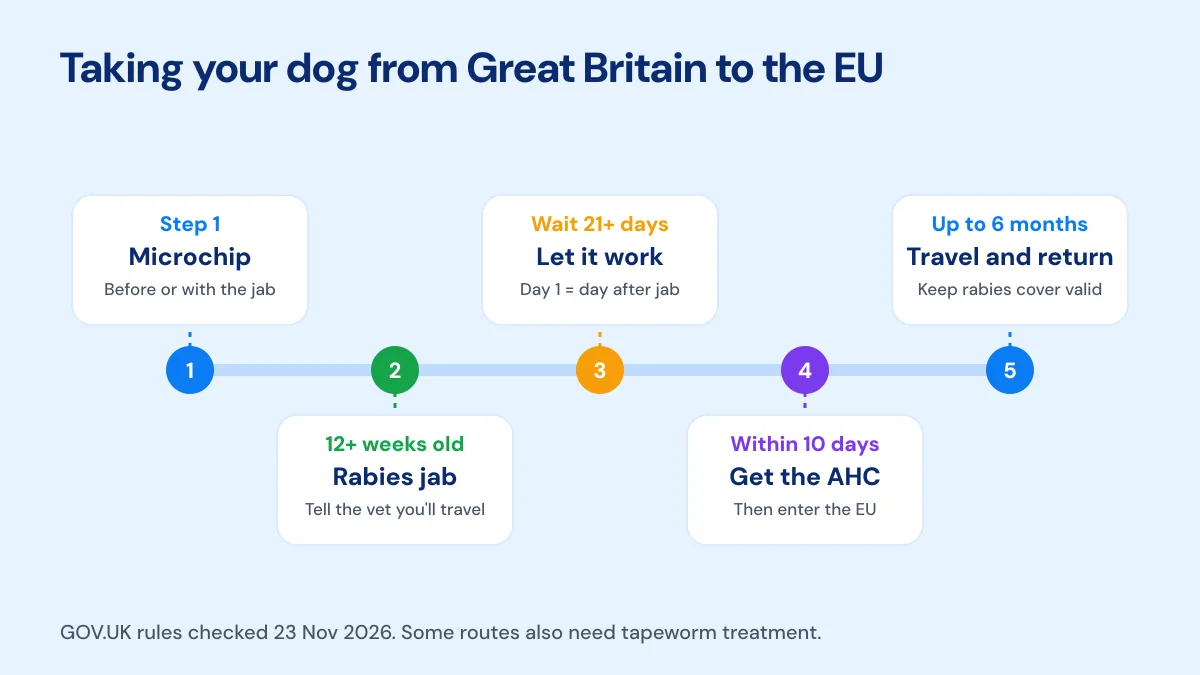
- Order matters: microchip first (or at the same visit), then rabies vaccine.
- Minimum age for the rabies vaccine is 12 weeks.
- Wait at least 21 full days after the first rabies vaccination; day 1 is the day after.
- Get the AHC within 10 days before entering the EU; it then covers onward EU travel and re-entry to GB for up to 6 months.
- Some routes (including Ireland, Northern Ireland, Malta, Finland and Norway) need a tapeworm treatment recorded by a vet.
- Reusable pet passports are expected to return under the new UK-EU deal, but are not available yet.
Step by step: getting your dog ready to travel
GOV.UK's rules for taking a dog, cat or ferret from Great Britain to the EU or Northern Ireland follow a fixed order. Getting it wrong, for example vaccinating before the microchip goes in, means starting again.
1. Microchip
GOV.UK says the microchip must go in before, or at the same time as, the rabies vaccination. Otherwise your dog will need to be vaccinated again.
2. Rabies vaccine (from 12 weeks old)
Your vet needs proof your dog is at least 12 weeks old. Tell them you plan to travel so the record is completed correctly.
3. Wait at least 21 days
Wait at least 21 full days after the first rabies vaccination (day 1 is the day after). Some vaccines take longer to work; ask your vet.
4. Animal Health Certificate
Your vet issues the AHC. You must enter the EU within 10 days of the issue date.
5. Tapeworm treatment if required
For dogs travelling directly to Finland, Ireland, Malta, Northern Ireland or Norway, a vet must give and record tapeworm treatment. Returning to Great Britain from some countries also needs a tapeworm treatment 1–5 days before arrival.
The Animal Health Certificate (AHC) explained
An AHC is the travel document for GB-resident pets going to the EU or Northern Ireland. GOV.UK says it is valid for entry to the EU for 10 days after issue, then for up to six months for onward travel within the EU and for re-entering Great Britain. The longer onward-travel validity came in with the EU rule changes of April 2026, but the AHC is still single-use: you need a new one for each trip from Great Britain.
- Up to five pets can go on one AHC.
- The rabies vaccination must stay valid for the whole trip, or the AHC cannot be used for onward travel or the return.
- You will sign a declaration that you are not selling or rehoming the pet.
- Book the AHC appointment early; not every vet issues them and slots fill up before holidays.
Are pet passports coming back? The 2027 update
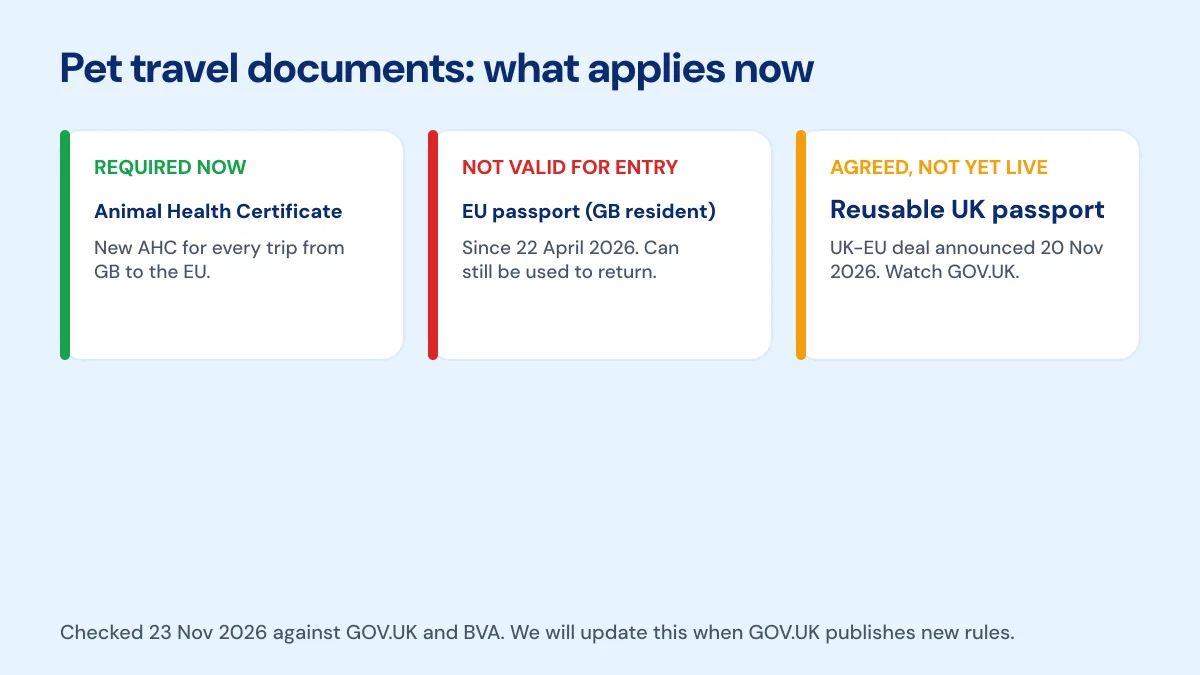
Since 22 April 2026, new EU rules mean GB residents should not use EU-issued pet passports to enter the EU, and the government advises getting an AHC instead. GB residents can still use an EU pet passport for the return journey to Great Britain.
On 20 November 2026, the UK and EU announced an agreement on food and animal standards (the SPS agreement) that is expected to bring back reusable pet passports for GB residents. The passports are not available immediately. GOV.UK has said it intends the SPS agreement to take effect in mid-2027, with detailed timings still being finalised, and some reports suggest pet passports could take longer.
| Document | Status now | What to do |
|---|---|---|
| Animal Health Certificate (AHC) | Required for each trip | Book with your vet within 10 days of entering the EU |
| EU-issued pet passport (GB resident) | Not valid for entry to the EU since 22 April 2026 | Use an AHC instead; it can still be used to return to GB |
| New reusable UK pet passport | Agreed in principle; not yet available | Watch GOV.UK; do not rely on it for 2027 bookings until confirmed |
Rabies boosters and keeping cover unbroken
PDSA says rabies vaccines are boosted every one to three years depending on the product. GOV.UK says you do not need to wait to travel after a booster if there has been no break in vaccine cover, but if a booster is missed the vaccination must be restarted, which may delay travel. The due date is shown on your AHC or pet passport.
Travelling to mainland Europe? Ask about the four-strain leptospirosis vaccine too: see L2 vs L4 explained. Back to the dog vaccinations UK guide.
Authoritative sources
Medical, regulatory and safety statements were checked against the following UK sources on 2026-11-23. Recheck changing regulations, travel rules, vaccination guidance and AI standards at least every 90 days or before a related decision.
- GOV.UK — Taking your pet dog, cat or ferret abroad
- GOV.UK — Rabies vaccinations and boosters
- GOV.UK — Getting an animal health certificate
- GOV.UK — Tapeworm treatment and AHC validity
- GOV.UK — Bringing your pet dog, cat or ferret to Great Britain
- GOV.UK — New EU rules for pet travel for GB residents
- BVA — Loophole closed on GB residents using EU-issued pet passports (22 April 2026)
- GOV.UK — SPS agreement: veterinary sector preparing your business
- PDSA — Dog vaccines (rabies)
Frequently asked questions
How old does a puppy have to be for the rabies vaccine?
At least 12 weeks old. With the 21-day wait after vaccination, the earliest a puppy can travel to the EU is around 15 weeks.
How long after the rabies vaccine can my dog travel?
At least 21 full days after the first vaccination, counting the day after vaccination as day 1. Some vaccines take longer; your vet will tell you.
How long is an Animal Health Certificate valid?
For entry to the EU, 10 days from issue. After that it can be used for onward travel within the EU and for returning to Great Britain for up to six months, as long as the rabies vaccination stays valid.
Are pet passports coming back in 2027?
A UK-EU agreement announced on 20 November 2026 is expected to bring back reusable pet passports, but they are not available yet and the start date has not been confirmed. Check GOV.UK before booking.
Does my dog need a rabies booster every year?
It depends on the vaccine: PDSA says every one to three years. Keep cover unbroken, because a missed booster means restarting and waiting again.