

Key takeaways
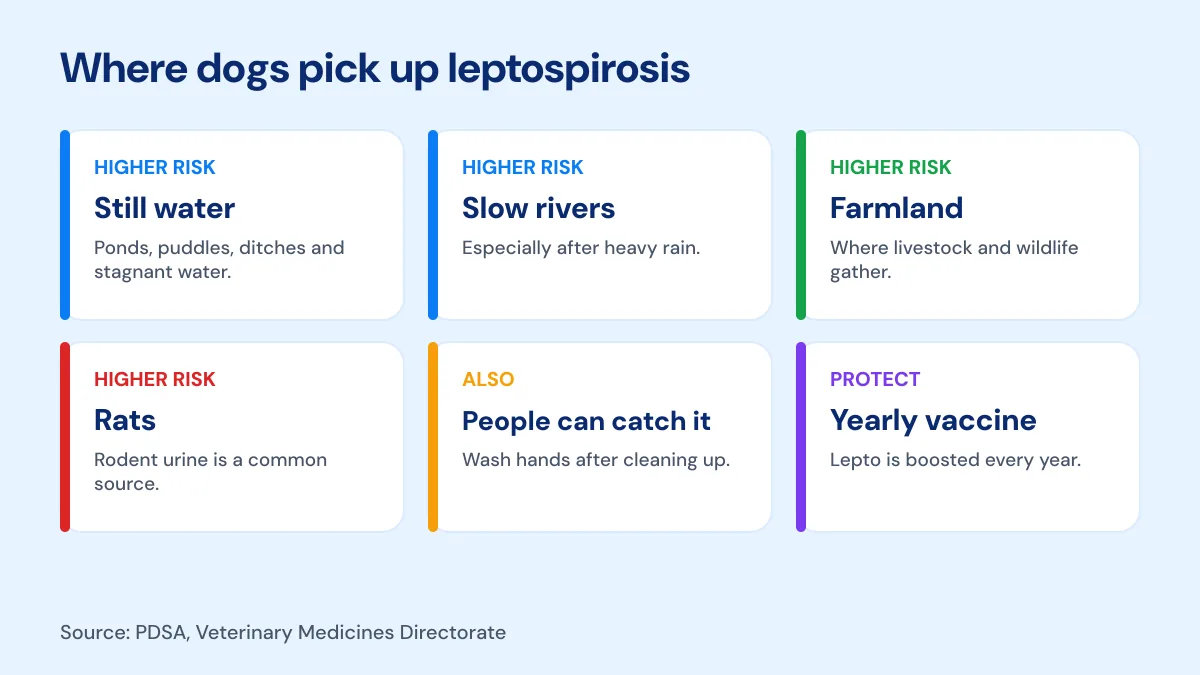
- Leptospirosis spreads through infected urine, contaminated water and soil; rodents are a common source.
- It can affect people as well as dogs, so protecting your dog also protects your household.
- L2 covers two serogroups; L4 adds two more that are known risks in mainland Europe.
- VMD data (March 2026): adverse events are rare for both, at about 0.016% (L2) and 0.040% (L4).
- Some L2 products have been withdrawn, so ask your practice what it stocks.
- The lepto component needs boosting every year.
What is leptospirosis and how do dogs catch it?
Leptospirosis is caused by Leptospira bacteria. They survive in wet environments such as ponds, slow rivers, puddles and ditches, especially where rats and farm animals are present. Dogs usually pick it up by drinking or swimming in contaminated water, or through contact with infected urine. It is a zoonosis, which means people can catch it too.
PDSA lists leptospirosis as one of the four core diseases every UK dog should be vaccinated against, and advises keeping dogs that are not fully protected away from farm fields, ponds, stagnant water and rivers.
L2 vs L4: what is the difference?
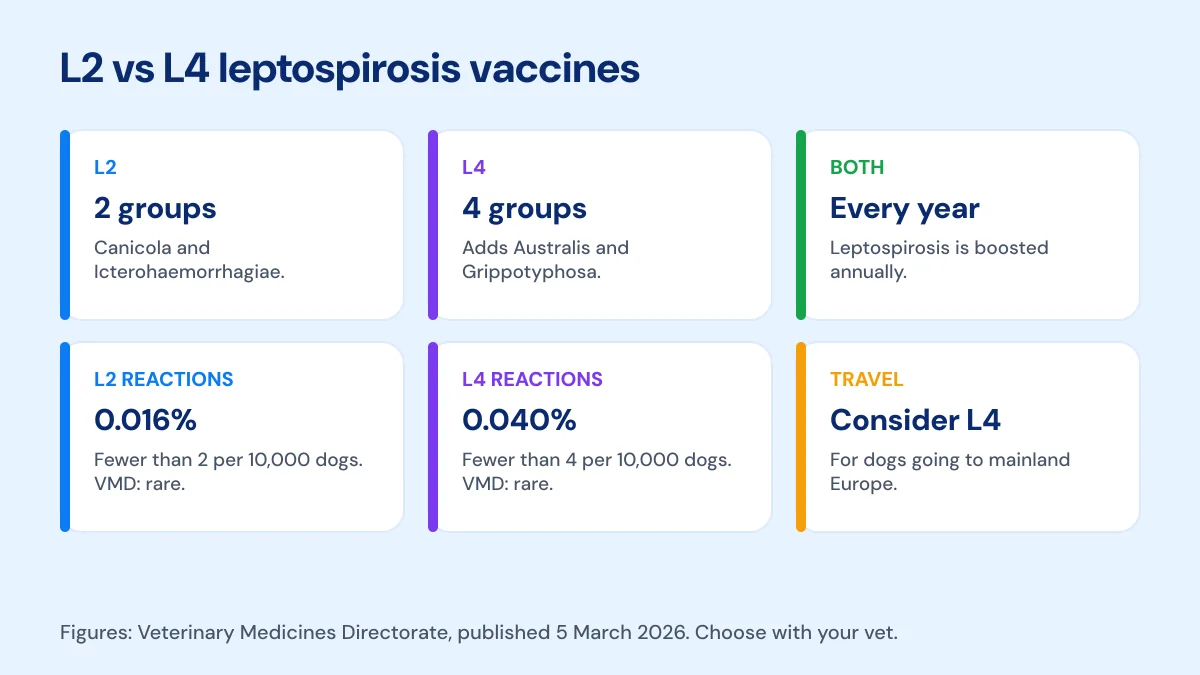
The number refers to how many groups of Leptospira bacteria the vaccine covers. The VMD confirms that vaccines with two strains (L2) and four strains (L4) are authorised in the UK.
| L2 | L4 | |
|---|---|---|
| Groups covered | 2 (Canicola and Icterohaemorrhagiae) | 4 (adds Australis and Grippotyphosa) |
| Reported adverse events | 0.016% (fewer than 2 per 10,000 dogs) | 0.040% (fewer than 4 per 10,000 dogs) |
| VMD classification | Rare | Rare |
| Often considered for | Dogs at lower local risk, where available | Dogs travelling to mainland Europe and higher-risk lifestyles |
| Booster interval | Every year | Every year |
How to decide with your vet
The VMD's advice is that vets should agree a vaccination plan for each dog, weighing the local leptospirosis risk against the potential side effects listed in the product information, and consider whether the extra cover of L4 is needed. Useful questions to bring:
- Which leptospirosis vaccine does the practice use, and why?
- How common is leptospirosis locally?
- Does my dog swim, hunt, visit farms or live near rats?
- Are we planning to travel to mainland Europe?
- Has my dog had any previous vaccine reaction?
- If we switch type, does the course need restarting?
Switching between L2 and L4 may mean a new two-dose course rather than a single booster, so check before you change.
Signs of leptospirosis
Early signs can be vague: lethargy, fever, vomiting, reduced appetite, increased thirst or jaundice (yellow gums or eyes). Leptospirosis can damage the kidneys and liver, so contact your vet promptly if your dog is unwell after swimming or contact with stagnant water, and tell them where your dog has been.
See the full schedule in our dog booster vaccinations guide, or go back to dog vaccinations UK.
Authoritative sources
Medical, regulatory and safety statements were checked against the following UK sources on 2026-11-23. Recheck changing regulations, travel rules, vaccination guidance and AI standards at least every 90 days or before a related decision.
Frequently asked questions
Is L4 more dangerous than L2?
Both are classed as rare-reaction vaccines by the VMD. Its March 2026 figures were 0.016% for L2 and 0.040% for L4. Talk to your vet about your dog's individual risk.
Does my dog need the lepto vaccine every year?
Yes. Leptospirosis protection lasts about a year, so it is boosted annually, unlike the core viral vaccines, which are usually every three years.
Should my dog have L4 if we travel to Europe?
The VMD advises vets to consider the four-strain vaccine for dogs travelling to mainland Europe, where the extra two groups are known risks.
Can people catch leptospirosis from dogs?
Yes, it can spread to people through infected urine. Wash hands after cleaning up and talk to your doctor if you feel unwell after contact with an infected dog.
Can I switch from L4 to L2?
Possibly, but changing vaccine type may require a new two-dose course. Ask your vet before the booster is due.